Streaming, I/O & Zero-Copy
High-throughput video pipelines cannot afford allocating and copying multi-megabyte frame buffers on every frame tick. go4vl provides two streaming APIs—a zero-copy iter.Seq2 iterator and a pooled channel pipeline—alongside four V4L2 I/O mechanisms (MMAP, UserPtr, DMA-BUF, and Read/Write), video output streaming, and poll/epoll readiness waiting.
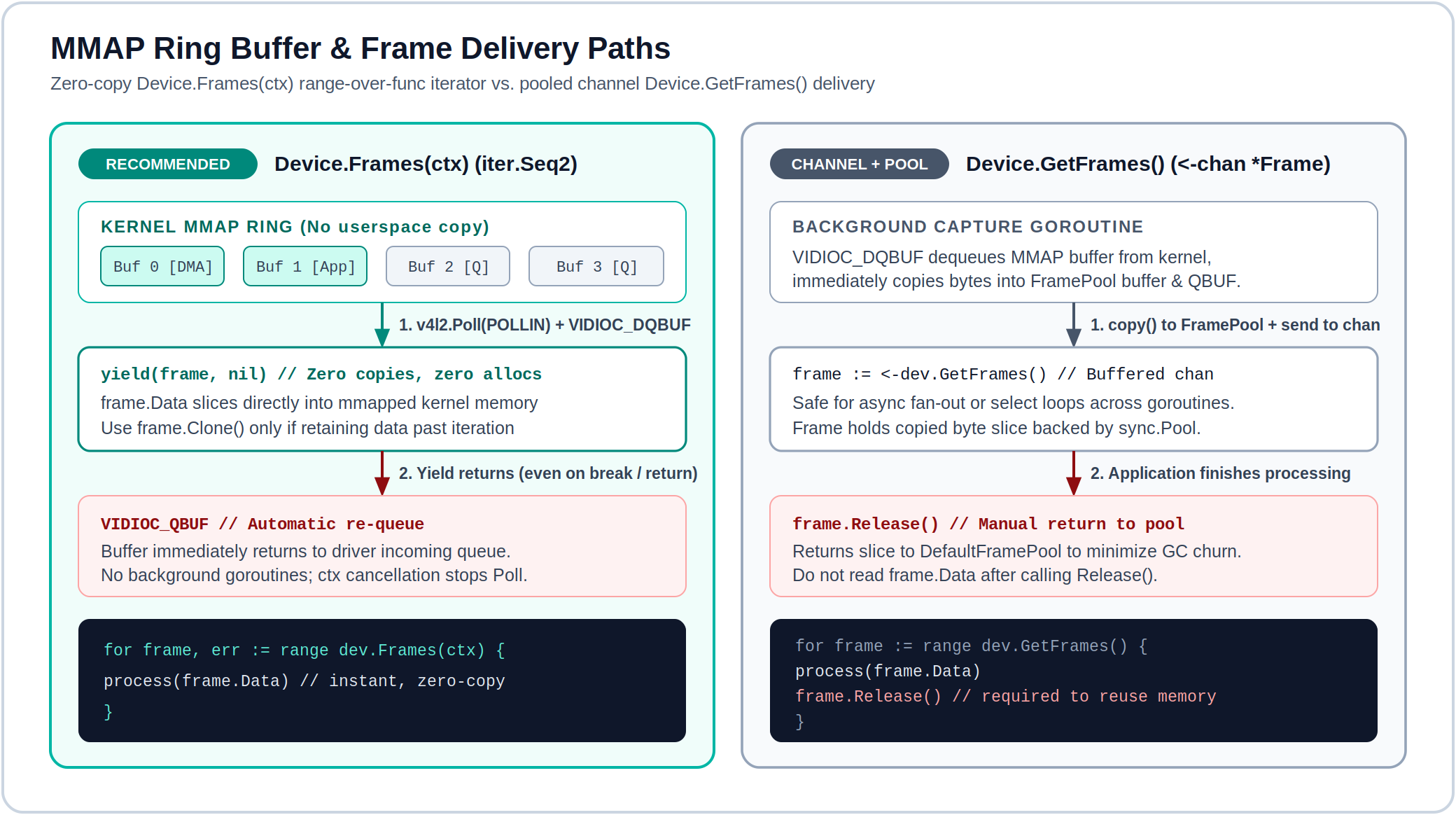
Zero-copy capture with Device.Frames(ctx)
Device.Frames(ctx) is the primary way to read captured frames in go4vl. Unlike the older channel capture loop, Frames(ctx) spawns zero background goroutines and performs zero per-frame heap copies:
if err := dev.Start(ctx); err != nil {
    log.Fatal(err)
}
defer dev.Stop()

for frame, err := range dev.Frames(ctx) {
    if err != nil {
        if errors.Is(err, context.Canceled) {
            break
        }
        log.Fatalf("frame error: %v", err)
    }

    // Zero-copy access to the kernel MMAP buffer.
    processPixels(frame.Data)
}
Inside each iteration:
Frames(ctx)waits synchronously usingv4l2.PollwithPollIn, responding immediately to context cancellation.- When ready, it dequeues one filled buffer (
VIDIOC_DQBUF) and constructs a*device.FramewhoseDataslice (orPlanesslices inMPLANEmode) points straight into the mapped buffer. - As soon as your loop body finishes an iteration—or exits early via
breakorreturn—Frames(ctx)automatically re-queues the buffer viaVIDIOC_QBUF.
Because kernel buffers wrap around as soon as they are re-queued, call frame.Clone() whenever you need to retain frame bytes past the current loop body. Do not call Frames(ctx) and GetFrames() simultaneously on the same started Device.
Pooled channel capture with Device.GetFrames()
When your architecture routes frames across multiple worker goroutines or multiplexes frame arrivals with other Go channels using select, call dev.GetFrames(). GetFrames() starts a capture goroutine that copies each dequeued kernel buffer into a buffer checked out from FramePool, immediately returns the kernel buffer to the driver, and sends the pooled *Frame on <-chan *Frame:
for {
    select {
    case <-ctx.Done():
        return
    case frame, ok := <-dev.GetFrames():
        if !ok {
            return
        }
        handleFrame(frame.Data)
        frame.Release() // return slice to FramePool to avoid GC pressure
    case err := <-dev.GetError():
        log.Printf("capture error: %v", err)
    }
}
Always call frame.Release() after processing completes so the underlying byte slice returns to DefaultFramePool(). Calling Release() multiple times on the same *Frame is a safe no-op, but never read frame.Data after releasing it.
Selecting an I/O mode (MMAP, UserPtr, DMA-BUF, Read/Write)
Memory-mapped streaming (v4l2.IOTypeMMAP) is the default because kernel drivers allocate DMA-capable buffers and expose them without copies. You can opt into alternative Linux V4L2 I/O modes using device.WithIOType and device.WithIOMethod:
- User Pointer (
device.WithIOType(v4l2.IOTypeUserPtr)): Allocates userspace buffers (v4l2.AllocateUserBuffers) and passes page pointers to drivers capable of scatter-gather DMA into application memory. Seeexamples/userptr_capture/. - DMA-BUF (
device.WithIOType(v4l2.IOTypeDMABuf)): Shares kernel DMA buffers across V4L2 devices, GPU textures, or DRM planes via file descriptors without CPU copies. Export MMAP buffers usingdev.ExportBuffer(index, flags)(orv4l2.ExportBufferPlanefor multi-planar) or register external DMA-BUF FDs viadev.AddDMABufferFDs(fds...). Seeexamples/dmabuf_export/. - Direct Read/Write (
device.WithIOMethod(device.IOMethodReadWrite)): For legacy drivers lacking streaming ring support, read and write directly viadev.ReadContext(ctx, buf)/dev.WriteContext(ctx, buf). Seeexamples/readwrite_capture/.
Video output streaming (WriteFrame and WriteFramePlanes)
To push frames into a hardware output device or a v4l2loopback virtual webcam, open the node with device.WithVideoOutputEnabled(), start it, and call dev.WriteFrame(ctx, frameBytes) (or dev.WriteFramePlanes(ctx, planes) for BufTypeVideoOutputMPlane):
dev, err := device.Open(
    "/dev/video10",
    device.WithVideoOutputEnabled(),
    device.WithBufferSize(4),
    device.WithPixFormat(v4l2.PixFormat{
        Width: 640, Height: 480, PixelFormat: v4l2.PixelFmtYUYV,
    }),
)
if err != nil {
    log.Fatal(err)
}
defer dev.Close()

if err := dev.Start(ctx); err != nil {
    log.Fatal(err)
}
defer dev.Stop()

if err := dev.WriteFrame(ctx, rawYUYVBytes); err != nil {
    log.Fatal(err)
}
WriteFrame fills all pre-allocated output buffers first, then waits for free buffers via v4l2.Poll(ctx, d.fd, v4l2.PollOut, ...) and dequeues completed frames automatically before copying your payload into the next slot and queueing it back to the kernel. See examples/video_output/.
Timestamps and dynamic buffer lifecycle
Linux V4L2 drivers typically tag captured frames using CLOCK_MONOTONIC rather than wall-clock UTC time. Pass device.WithTimestampMode to control how Frame.Timestamp is computed:
v4l2.TimestampDefault— interpretstimevaldirectly (time.Unix).v4l2.TimestampAuto— inspects buffer flags (BufFlagTimestampMonotonic) and adjusts monotonic timestamps into wall-clocktime.Time.v4l2.TimestampMonoToAbs— always converts monotonic kernel timestamps to wall-clocktime.Time.
At the low-level v4l2 layer, you can also prepare buffers off the hot path with v4l2.PrepareBuffer (VIDIOC_PREPARE_BUF), allocate extra buffers during active streaming via v4l2.CreateBuffers (VIDIOC_CREATE_BUFS), and release buffers on Linux 6.10+ via v4l2.RemoveBuffers (VIDIOC_REMOVE_BUFS).
Readiness polling with v4l2.Poll and v4l2.Poller
For single-device readiness checks without goroutines, call v4l2.Poll(ctx, fd, v4l2.PollIn|v4l2.PollOut|v4l2.PollPri, timeout). When orchestrating multiple file descriptors at once—such as an M2M decoder fd, a MediaRequest fd, and an input capture device—use v4l2.Poller, which wraps Linux epoll with an internal eventfd so ctx cancellation wakes Wait immediately:
poller, err := v4l2.NewPoller()
if err != nil {
    log.Fatal(err)
}
defer poller.Close()

_ = poller.Add(dev.Fd(), v4l2.PollIn|v4l2.PollPri)
results := make([]v4l2.PollResult, 4)
n, err := poller.Wait(ctx, results, 100*time.Millisecond)
Each entry in results[:n] identifies the ready file descriptor and bitmask (PollIn, PollOut, PollPri, PollErr, PollHup).