Codecs & Memory-to-Memory Pipelines
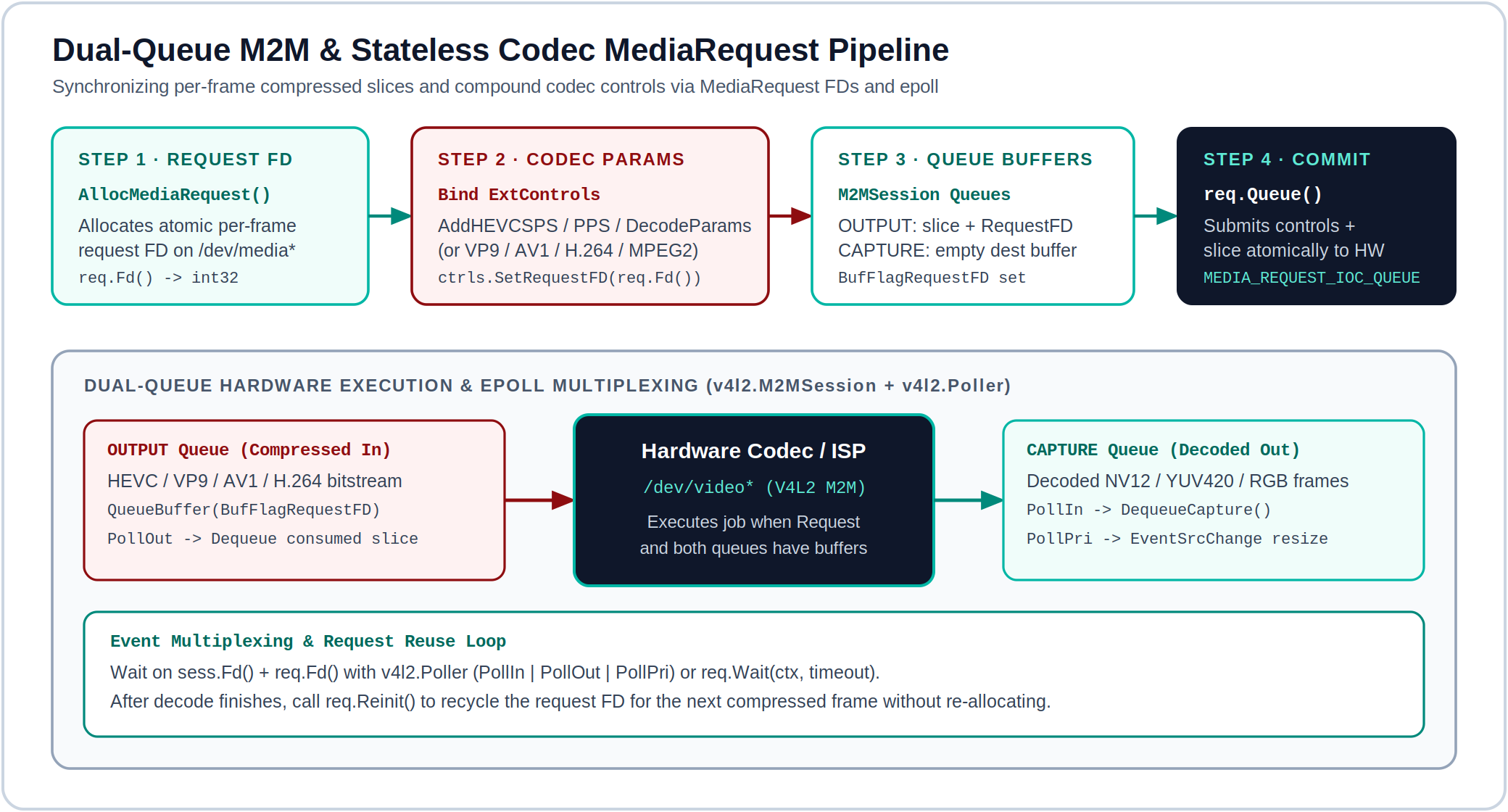
Hardware scalers, color-space converters, ISPs, and video encoders/decoders operate as V4L2 memory-to-memory (M2M) devices with two independent buffer queues on a single file descriptor: an OUTPUT queue accepting input frames or compressed bitstreams from your application, and a CAPTURE queue emitting processed or decoded buffers back to your application. go4vl provides both stateful high-level Encoder/Decoder wrappers and low-level M2MSession + MediaRequest primitives for stateless decoders.
Stateful hardware encoding and decoding (device.Encoder / device.Decoder)
For stateful V4L2 M2M hardware (such as Raspberry Pi's stateful H.264 encoder/decoder), device.OpenEncoder and device.OpenDecoder manage dual-queue formats, MMAP buffers, codec commands (Start, Drain, Flush, Stop), and resolution-change events behind Go channels:
enc, err := device.OpenEncoder("/dev/video11", device.EncoderConfig{
    InputFormat: v4l2.PixFormat{
        Width:       1280,
        Height:      720,
        PixelFormat: v4l2.PixelFmtYUV420,
    },
    OutputFormat: v4l2.PixFormat{
        PixelFormat: v4l2.PixelFmtH264,
    },
    Bitrate: 2_000_000,
    GOPSize: 30,
})
if err != nil {
    log.Fatal(err)
}
defer enc.Close()

if err := enc.Start(ctx); err != nil {
    log.Fatal(err)
}

go func() {
    enc.GetInput() <- rawYUVFrame
    _ = enc.Drain() // signal end of stream via V4L2_ENC_CMD_STOP
}()

for pkt := range enc.GetOutput() {
    writeH264(pkt)
}
When decoding streams that change resolution dynamically mid-stream (V4L2_EVENT_SOURCE_CHANGE), Decoder surfaces typed geometry updates through dec.GetResolutionChanges(). See examples/h264_encoder/ and examples/h264_decoder/.
Low-level dual-queue M2M with v4l2.M2MSession and v4l2.Poller
When driving hardware ISPs, image scalers, or stateless decoders where you manage buffer flags, DMA-BUF file descriptors, or MediaRequest synchronization directly without background goroutines, use v4l2.OpenM2M:
sess, err := v4l2.OpenM2M("/dev/video12")
if err != nil {
    log.Fatal(err)
}
defer sess.Close()

// Auto-detects MPLANE vs single-planar M2M when BufType is zero, or specify explicitly:
if err := sess.SetupOutput(v4l2.M2MQueueConfig{Count: 4, Memory: v4l2.IOTypeMMAP}); err != nil {
    log.Fatal(err)
}
if err := sess.SetupCapture(v4l2.M2MQueueConfig{Count: 4, Memory: v4l2.IOTypeMMAP}); err != nil {
    log.Fatal(err)
}

poller, _ := v4l2.NewPoller()
defer poller.Close()
_ = poller.Add(sess.Fd(), v4l2.PollIn|v4l2.PollOut|v4l2.PollPri)
sess.Output and sess.Capture expose mapped plane slices (Planes[bufIdx][planeIdx]), buffer counts, and queue helpers (StartOutput, StartCapture, StopOutput, StopCapture, QueueOutput, QueueCapture, DequeueOutput, DequeueCapture). Combining M2MSession with v4l2.Poller lets a single goroutine handle PollOut (input slot free), PollIn (processed frame ready), and PollPri (source-change event) cleanly. See examples/m2m_pipeline/.
Stateless decoding with MediaRequest and compound codec controls
Stateless decoders (such as Raspberry Pi 4/5 rpi-hevc-dec, Hantro, Cedrus, and RKVDPU) require userspace parsers to supply per-frame codec syntax headers alongside compressed slice data atomically via the Linux Media Request API (/dev/media*).
go4vl includes checked-in compound UAPI structs and ExtControls helpers across seven stateless codec families:
- HEVC:
AddHEVCSPS,AddHEVCPPS,AddHEVCSliceParams,AddHEVCScalingMatrix,AddHEVCDecodeParams - H.264:
AddH264SPS,AddH264PPS,AddH264ScalingMatrix,AddH264SliceParams,AddH264DecodeParams,AddH264PredWeights - VP9:
AddVP9Frame,AddVP9CompressedHdr - VP8:
AddVP8Frame - AV1:
AddAV1Sequence,AddAV1TileGroupEntry,AddAV1Frame,AddAV1FilmGrain - MPEG2:
AddMPEG2Sequence,AddMPEG2Picture,AddMPEG2Quantization - FWHT:
AddFWHTParams
Validate compound controls with VIDIOC_TRY_EXT_CTRLS first, bind them to an allocated MediaRequest FD, attach the same req.Fd() to the OUTPUT slice buffer (RequestFD with BufFlagRequestFD), queue the request atomically, wait for completion, and recycle the request with Reinit():
req, err := v4l2.AllocMediaRequest(mediaFD)
if err != nil {
    log.Fatal(err)
}
defer req.Close()

ctrls := v4l2.NewExtControls()
_ = ctrls.AddHEVCSPS(&v4l2.ControlHEVCSPS{
    Pic_width_in_luma_samples:  1920,
    Pic_height_in_luma_samples: 1080,
    Chroma_format_idc:          1,
})
_ = ctrls.AddHEVCPPS(&v4l2.ControlHEVCPPS{})
_ = ctrls.AddHEVCDecodeParams(&v4l2.ControlHEVCDecodeParams{})

if err := v4l2.TryExtControls(videoFD, ctrls); err != nil {
    log.Fatalf("try hevc controls: %v", err)
}

ctrls.SetRequestFD(req.Fd())
if err := v4l2.SetExtControls(videoFD, ctrls); err != nil {
    log.Fatalf("bind request controls: %v", err)
}

// Queue matching compressed slice buffer with buf.RequestFD = req.Fd() and
// buf.Flags = v4l2.BufFlagRequestFD, then submit atomically:
if err := req.Queue(); err != nil {
    log.Fatalf("queue request: %v", err)
}
_, _ = req.Wait(ctx, time.Second)
_ = req.Reinit()
Note that TryExtControls validates driver parameter constraints before binding to MediaRequest via SetExtControls, preventing rejected slice setups on drivers such as rpi-hevc-dec. See examples/media_request/ and examples/stateless_hevc/.